
What a Guided Psilocybin Session in the Netherlands Looks Like
Much of what a guided psilocybin session can do is decided before the day itself begins. The substance never works in a vacuum. It works in a particular state of mind, in a particular place, in a particular form of support. A pooled analysis of 23 controlled studies involving 261 people found that, alongside dose, it is mainly non-pharmacological factors that shape the effects of psilocybin: the inner state before ingestion and the environment in which it happens [1]. Research has gathered these two under a single heading since the 1960s: set and setting [2].
Both of these can be shaped. How a session is built is therefore not an organisational matter. It helps determine what becomes possible. This article describes, in order, how we work in the Netherlands, from the first conversation to the weeks that follow.
The Process at a Glance
A session is more than a single day. It runs over several weeks and follows six steps.
Discovery call. A half-hour conversation, free and with no obligation, in which we work out what brings you here and whether the work is right for you.
Screening. A careful look at your medical history and where you are in life right now, to establish whether a session is advisable for you.
Experience design. Shaping the whole experience together, tailored to you and your intention.
Preparation. Several weeks in which the real work has already begun.
The session day. The guided experience itself, a day or more, with an overnight stay on site.
Integration. The weeks afterwards, in which the experience becomes something that lasts.
The discovery call and screening come at the start and are quickly explained. In the discovery call we establish whether the work fits what you are looking for. The screening checks whether a session is advisable: a personal or family history of psychotic illness, bipolar disorder, uncontrolled high blood pressure or relevant cardiac arrhythmias, an acute crisis, or medication such as lithium or MAO inhibitors can make a session unwise or risky at a given point in time [3, 4]. We are honest about this. Sometimes it means: not now, or something else would suit you better. In those cases, we point you somewhere more fitting. The four steps that follow are the real heart of the work.
Experience Design
This is where our work differs most clearly from an off-the-shelf retreat. A conventional group retreat has a fixed schedule that participants fit into. With us it is the other way round: we build the experience around the person.
The starting point is two questions: what do you need, and what do you want to reach? Everything else follows from the answers. We set the format, whether you work one to one, as a couple, in a private group of people who already know each other, or in an open small group we put together ourselves. We choose the place, from a quiet country house with a garden to a private estate with a private chef and generous grounds. We decide the length of the stay, the number of preparation and integration sessions, the music, the food, and the small things that make a day bearable.
Each of these elements changes how a session feels. Which format suits whom is a subject in its own right, and we cover it in a separate article. What they all share: they are chosen for you and your intention, not for an imagined average case. With female clients, a female facilitator is always present in the room.
What deliberately has no place in our work: shamanic ritual, incense, and spiritual dogma. Elements like these impose a meaning on an experience from the outside, before it has even taken shape. We keep the space open, so that whatever surfaces can find its own meaning for you. For a different reason, we make no therapeutic diagnoses and give no promise of healing: this is a matter of professional integrity. Making a diagnosis is the task of suitably trained clinicians, and a promise of healing would claim an outcome that cannot be guaranteed.
Preparation
The weeks before the session day are already part of the work. Across at least two sessions, usually an hour each, we clarify your intention, the inner and outer frame, and whatever is weighing on you. You learn simple anchors for intense moments, small things you can lean on during the session.
Why does preparation matter so much? Because the experience on the session day builds on what came before it: trust, clarity about your intention, a sense of safety. Often these conversations bring the first changes on their own, well before anything is taken. They help shape what the experience can become.
The Session Day
What happens during a psilocybin session? A guided psilocybin session moves through four phases: arriving and settling into the room, ingestion, an active phase of four to five hours at varying intensities, and a wind-down with a gradual return. The session day as a whole runs about eight to ten hours.
The day begins quietly. We recommend coming on a largely empty stomach: it is gentler on the body and lets the effects come on more softly. The room is prepared: a comfortable place to lie down and everything you need over the course of the day.
We work with two doses rather than one, both calibrated to you. You first drink a smaller amount of the truffle tea. After about thirty minutes the effects begin, often physically at first, as a light tingling or a warmth. Many people wonder at this point whether they are doing it right. There is nothing to achieve here.
After about an hour and a half, a second cup is ready. It is optional, and you decide whether to take it. Over the years we have found that clients come into the experience more gently and, at the same time, more deeply this way, because the body is given time to adjust to the shift in perception.
For most of the active phase you lie down, with an eye mask or your eyes closed, listening to music that was discussed beforehand and can be adjusted during the session. What happens then is individual. Inner images, intense emotions, old memories, and an altered sense of time and body are common. The content cannot be forced, but preparation, set, and setting all shape the direction an experience takes. Some people move through wide, quiet spaces; others work through something concrete that has waited a long time. Both are part of the same work. The effects come in waves: phases of high intensity alternate with calmer stretches, where you surface, get your bearings, perhaps take a sip of water.
Even in the intense phases you remain reachable. What you cannot do is stop the effects; once they have begun, they follow their own course. What you can do is speak up at any time, say something, or reach for a hand. Someone is always there.
How long does a psilocybin session last? The acute phase usually lasts four to five hours, followed by a wind-down of one to three hours. When the effects ease, the return begins, a phase of its own that is given its own time. An overnight stay at the session location is part of how we work.
How We Are Present During the Session
During the active phase we hold back on interpretation. That restraint is a choice. What rises in a session should take its own course and not be steered in someone else's direction. We read what is happening in the room, regulate the environment, and stay in contact without leading.
What sets our work apart from simply being present: we hold a safe frame throughout the day and support you actively wherever you need us. We have prepared what surfaces on the session day with you in the weeks beforehand, and we keep working with it in the weeks that follow. We work in a trauma-informed way: when difficult passages come, we stay closer and help you remain in the body. With us you can let go completely, without having to take care of anything. For the rare cases of acute complication, we have a clear protocol with medical support reachable at the session location, which we set out openly during the preparation conversation.
Integration
An experience on its own rarely changes anything lasting. What makes the difference are the weeks afterwards, when what was lived finds its way back into everyday life.
Straight after the acute phase, we stay with you as you arrive back. There is warm tea and something light to eat, a quiet evening with no programme, and the chance to step outside for fresh air if you feel like it. You stay the night at the session location and travel home only the next day.
The first integration conversation happens soon after, ideally within 24 hours, at the latest within a week. Researchers describe the weeks after a session as a period of heightened psychological flexibility, when new patterns of thought and behaviour are easier to establish [5]. Integration work uses that window: across several sessions, we order the experience and translate it into concrete steps, into new habits, into changed decisions, into the way you run your daily life [6]. At the next meeting we look at what is holding, and adjust. An insight that stays inside the room of the session often fades within weeks; only the translation into lived routine makes it last. The number of sessions varies. Some need two or three, others keep working over months.
Is psilocybin legal in the Netherlands? Psilocybin-containing truffles are legally available to adults in the Netherlands. They fall under an exception in Dutch drug law that treats truffles differently from the fruiting bodies of mushrooms. We clarify both the legal and the practical framework with you in full during the discovery call.
If this article has left questions open, the discovery call is the place to ask them. In that conversation we look together at whether, and in what form, a session is the right path for you.
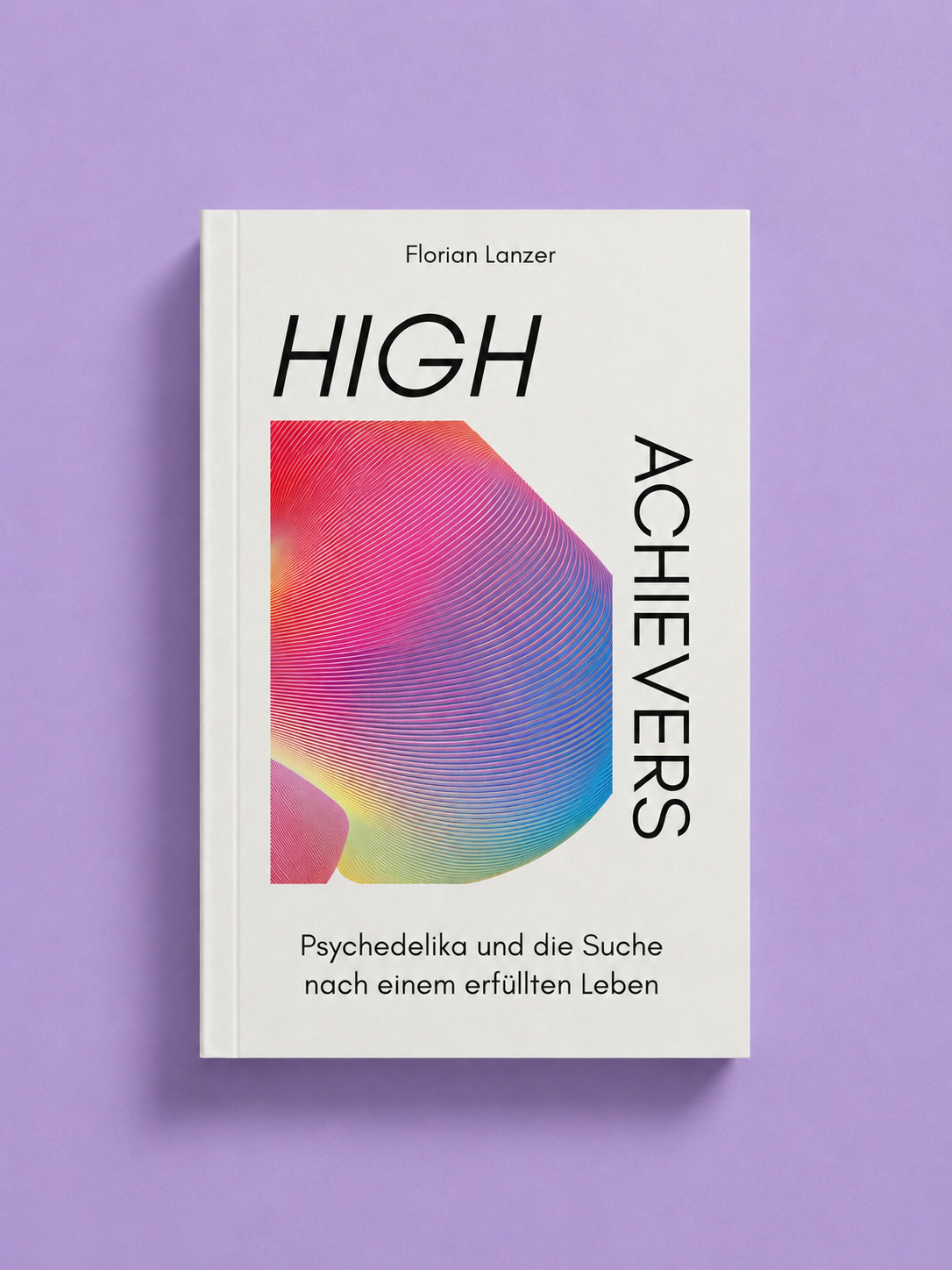
If you would like to read more deeply about how this work unfolds over the months after a session, it is covered at length in the book High Achievers – Psychedelics and the Search for a Meaningful Life.
Sources
[1] Studerus E, Gamma A, Kometer M, Vollenweider FX. Prediction of Psilocybin Response in Healthy Volunteers. PLOS ONE 2012;7(2):e30800.
[2] Hartogsohn I. Constructing drug effects: A history of set and setting. Drug Science, Policy and Law 2017;3:1-17.
[3] Johnson MW, Richards WA, Griffiths RR. Human hallucinogen research: guidelines for safety. Journal of Psychopharmacology 2008;22(6):603-620.
[4] Halman A, Kong G, Sarris J, Perkins D. Drug-drug interactions involving classic psychedelics: A systematic review. Journal of Psychopharmacology 2024;38(1):3-18.
[5] Watts R, Luoma JB. The use of the psychological flexibility model to support psychedelic assisted therapy. Journal of Contextual Behavioral Science 2020;15:92-102.
[6] Bathje GJ, Majeski E, Kudowor M. Psychedelic integration: An analysis of the concept and its practice. Frontiers in Psychology 2022;13:824077.